
By HomeShield Restoration · Updated
Do crawl space dehumidifiers actually work?
Yes, a crawl space dehumidifier works by pulling moisture out of the air and sending the collected water to a drain. It works best as one part of a coordinated plan, where the space is lined and sealed so the unit isn't fighting a constant supply of new moisture. On its own, in a vented crawl space with bare soil, it can run all day and still struggle to keep up. So the honest answer is that the equipment does what it's built to do. Whether it solves your problem depends on everything else going on under the house.
How does a crawl space dehumidifier remove moisture?
A dehumidifier draws air across a cold coil. Moisture in the air condenses on the coil, the same way water beads on a cold glass on a humid day, and drips into a collection area. The drier air goes back into the space. The collected water, called condensate, has to go somewhere, so crawl space units are usually set up to drain through a hose or pump to a discharge point. Most units run off a humidity setting and switch on when the air gets above it. Over time that helps keep the air in an enclosed crawl space more stable from season to season.
Why isn't a dehumidifier enough on its own?
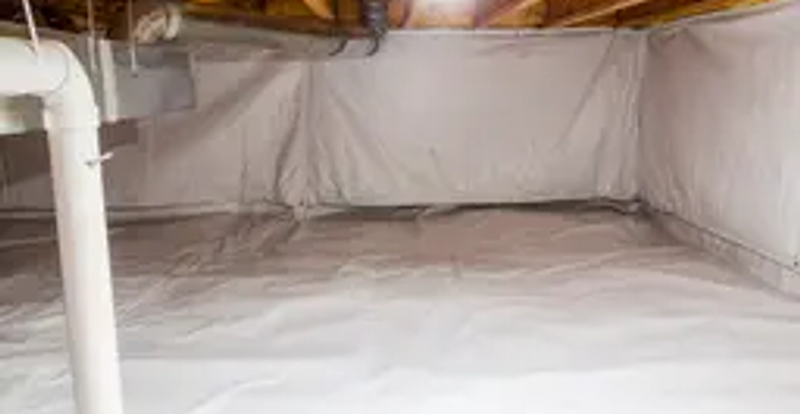
A dehumidifier treats the air. It doesn't stop the sources of moisture. If outside air pours in through open vents all summer, or bare soil keeps releasing vapor, the unit is trying to dry a space that keeps getting wet again. In Moore County, where summers are long, hot, and humid, that's a lot of air to dry. The unit may run nearly nonstop, wear out sooner, and still fall behind. That's why dehumidifiers are usually paired with a ground and wall liner and sealed openings, so the unit only has to handle the moisture that's left.
Can a dehumidifier fix a leak or standing water?
No. If there's water on the ground from a plumbing leak, a drain line, or rain running in from outside, the dehumidifier will pull some of that moisture out of the air as it evaporates, but the source keeps feeding it. Standing water needs to be traced and stopped, whether that means a plumbing repair, gutter and grading changes outside, or drainage work in the crawl space. Running a unit over a wet floor can hide the problem for a while without solving it. Fix the water first, then decide how much humidity control the space needs.
What size dehumidifier does a crawl space need?
Sizing depends on the crawl space volume, how well it's sealed, how much moisture is coming in, and how air moves around piers and ductwork. A unit that's too small runs constantly. A bigger unit isn't always better if air can't reach the far corners. Placement matters too. The unit needs clearance for airflow and for someone to service it, clean filters, and check the drain. It also needs a suitable power source, and if one isn't already there, that's work for a licensed electrician. These details belong in the written scope, not left to guesswork after installation.
Where does the water from a crawl space dehumidifier go?
The condensate has to leave the crawl space, or you've only moved the moisture a few feet. Units are typically connected to a drain line, and where gravity drainage isn't practical, a condensate pump moves the water out. The discharge point should carry water away from the foundation instead of dumping it right back beside the house. Ask how the drain will be routed, what happens if a line clogs or a pump fails, and how you would notice. A drainage problem is one of the more common reasons a dehumidifier quietly stops doing its job.
How much maintenance does a crawl space dehumidifier need?
Plan on regular checks. Filters need cleaning or replacement, drain lines can clog, and coils collect dust over time. Some homeowners set a reminder to look at the unit a few times a year, while others prefer a service visit. Warranty coverage varies by product, so ask what the manufacturer covers, for how long, and what's required to keep it valid. That's separate from any installer guarantee. At HomeShield Restoration, qualifying full encapsulations carry a 25-year guarantee and qualifying partial encapsulations a 10-year guarantee, subject to written terms, so ask how the equipment fits into those terms.
What does a dehumidifier cost as part of a crawl space project?
The unit is only part of the cost. Installation, drainage, any electrical work, and the liner and sealing that make the unit effective all add up. For planning, HomeShield Restoration's typical restoration projects run around $8,000 to $12,000, and some smaller scopes come in around $2,000. Those are examples, not quotes. Where your project lands depends on what else the crawl space needs. The useful comparison is between complete written scopes, not between the price tags of two machines.
How do I find out if my crawl space needs a dehumidifier?
Start with an on-site assessment. We look at the ground, any existing liner, openings, insulation, ducts, and signs of water entry, and document it all with photos and video so you can see the conditions yourself. From there we can tell you whether a dehumidifier makes sense and what should come first. HomeShield Restoration is locally owned in Aberdeen and serves Pinehurst, Southern Pines, and the surrounding Sandhills. Request an inspection online or call (910) 702-2400.
General educational information. It is not a structural, environmental, or medical evaluation. Recommendations for your property require an on-site assessment.
Get Answers About My Home ↗